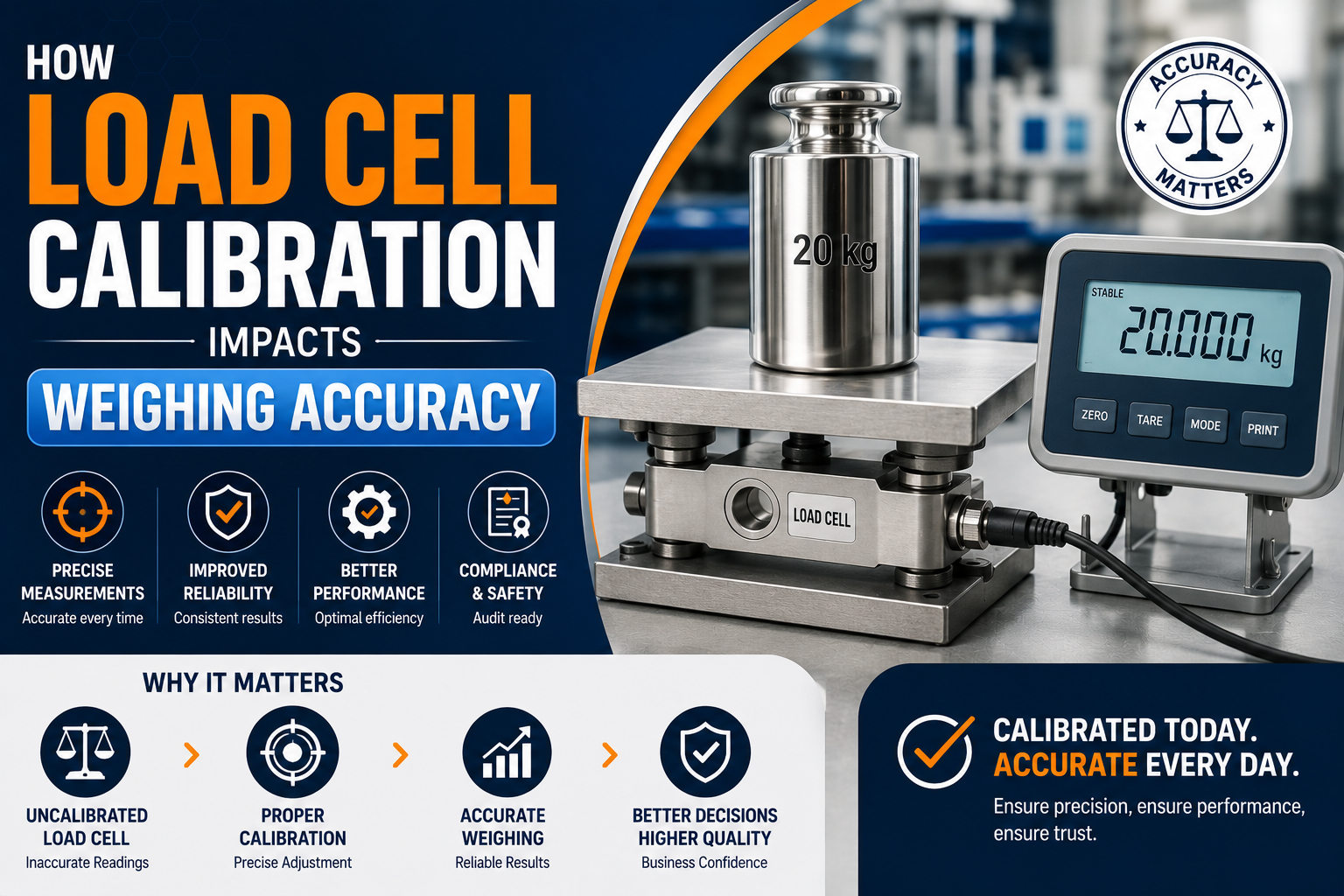
How Load Cell Calibration Impacts Weighing Accuracy: The Ultimate UAE Industrial Guide
In the high-stakes world of UAE industrial operations—spanning from the petrochemical refineries of Abu Dhabi and the massive logistics hubs of Jebel Ali to the bustling construction sites across Dubai—precision is not merely a goal; it is a regulatory, operational, and financial necessity. At the heart of this precision lies the load cell, the unsung hero of industrial weighing, force measurement, and process automation.
Whether measuring raw aggregates in a concrete batching plant, monitoring tank capacities in a chemical facility, or ensuring the safe load limits of offshore cranes, load cells provide the critical data that drives decision-making. However, like all high-precision instruments, load cells are susceptible to mechanical wear, environmental degradation, and operational stress. Without regular, traceable load cell calibration, even the most advanced industrial weighing systems will yield erroneous data, leading to costly manufacturing defects, regulatory penalties, and severe safety hazards.
This comprehensive technical guide explores how load cell calibration directly impacts weighing accuracy, the physics behind measurement drift, the unique environmental challenges faced by UAE industries, and the best metrology practices required to maintain peak operational performance.
—
What is a Load Cell and Why Does It Drift?
To understand the necessity of calibration, one must first understand how a load cell translates physical force into a readable digital weight value. A load cell is an electro-mechanical transducer. Most industrial load cells rely on strain gauge technology configured in a Wheatstone bridge circuit.
Understanding Load Cell Mechanics
When a physical load is applied to the load cell’s metal body (typically alloy steel, stainless steel, or aluminum), the spring element undergoes elastic deformation. This minute deflection stretches or compresses the bonded strain gauges, changing their electrical resistance ($\Delta R$).
By applying an excitation voltage to the Wheatstone bridge, this resistance change is converted into a differential analog output signal, typically measured in millivolts per volt (mV/V). A digital weight indicator then amplifies, filters, and digitizes this micro-signal, displaying it as a weight value (e.g., kilograms, tonnes, or Newtons).
The Phenomenon of Calibration Drift
In a perfect world, a load cell would maintain a perfectly linear relationship between the applied force and the electrical output indefinitely. However, physical systems are subject to real-world degradation known as calibration drift. Drift is the gradual deviation of the load cell’s output from its established reference standard over time. Key drivers of drift include:
- Mechanical Fatigue: Repetitive loading cycles cause micro-structural changes in the metal spring element, slightly altering its elastic properties.
- Structural Overloading: Subjecting a load cell to a force beyond its Rated Capacity (RC)—even momentarily—can cause permanent plastic deformation of the element, shifting the zero-balance permanently.
- Shock Loading: Sudden, violent impacts (e.g., dropping a heavy container onto a scale platform) cause transient stresses that compromise structural integrity and strain gauge alignment.
- Environmental Aging: Continuous exposure to temperature fluctuations, humidity, and corrosive chemical vapors degrades the adhesives bonding the strain gauges to the substrate, as well as the protective potting compounds.
Because drift happens gradually, operators rarely notice the decline in accuracy day-to-day. Only systematic calibration against certified reference standards can detect and correct this deviation.
—
The Core Importance of Load Cell Calibration for Weighing Accuracy
Weighing accuracy is not a static attribute of a scale; it is a dynamic state maintained through systematic verification. The impact of load cell calibration on this accuracy is profound, directly affecting three critical areas of industrial operations: financial viability, safety, and process quality.
1. Preventing Costly Measurement Errors
In B2B industrial transactions, weight translates directly to currency. Under-measuring leads to product giveaway (loss of revenue), while over-measuring leads to short-changing customers, which can damage reputation and trigger severe legal disputes under UAE legal metrology framework managed by the Ministry of Industry and Advanced Technology (MoIAT).
Consider a cement batching plant in Abu Dhabi producing high-performance concrete mixes. If the load cells on the aggregate and cement hoppers drift by just 1.5%, the resulting concrete mixture will fail to meet structural strength specifications. The batch must be rejected, costing thousands of Dirhams in wasted materials, transport, and project delays.
2. Ensuring Operational Safety and Risk Mitigation
In heavy lifting, marine, and construction engineering, accurate load monitoring is a matter of life and death. Cranes, hoists, and mooring systems rely on tension links and shear pin load cells to prevent catastrophic structural failure.
If a load cell’s sensitivity drifts downward, the crane control system may not detect an overload condition. The resulting mechanical failure can lead to equipment destruction, project halts, and severe personnel injuries. Regular calibration ensures that overload limit switches trip precisely when they should, maintaining compliance with federal occupational health and safety regulations in the UAE.
3. Maximizing Process Quality and Recipe Consistency
For chemical processing, pharmaceutical manufacturing, and food packaging industries in the UAE, recipe consistency is paramount. Automated batching systems rely on highly precise ingredient dispensing. Even minor deviations in load cell output can ruin entire batches, leading to production downtime and compromised product efficacy.
—
The Science of Calibration: How It Is Performed
Load cell calibration is a highly controlled metrological procedure that establishes the relationship between the input force (the reference standard) and the electrical output of the load cell system. This process must be conducted by an ISO/IEC 17025 accredited laboratory to ensure traceabilty to national and international standards.
| Calibration Metric | What It Measures | Operational Significance |
|---|---|---|
| Linearity | The maximum deviation of the calibration curve from a straight line drawn between zero and maximum capacity. | Ensures weighing accuracy remains consistent across the entire range of the scale, not just at zero and full capacity. |
| Hysteresis | The difference in output readings for the same applied load when approached from zero load versus when approached from maximum capacity. | Critical for batching processes where materials are continuously added (loading) and discharged (unloading). |
| Repeatability | The ability of the load cell to produce identical readings when the same load is applied repeatedly under identical conditions. | Ensures process uniformity and predictability over continuous manufacturing runs. |
| Zero Balance | The output signal of the load cell when no load is applied. | Detects whether the load cell has suffered permanent structural damage or overload. |
Zero Calibration vs. Span Calibration
A standard industrial calibration procedure consists of two primary adjustments:
- Zero Calibration: Adjusting the weighing indicator to read “0” when the scale is completely empty. This compensates for the dead load of the weighing structure (the scale platform, hopper, or vessel).
- Span Calibration: Applying a known, certified reference mass (typically equal to 80% to 100% of the scale’s maximum capacity) and adjusting the indicator’s gain so that the displayed value matches the reference weight.
Metrological Traceability
Calibration is meaningless without metrological traceability. This means the reference weights used by the calibration technician must be calibrated against secondary standards, which are calibrated against primary national standards, eventually tracing back to the International System of Units (SI). In the UAE, calibration services must be traceable to the National Metrology Institute (NMI) overseen by MoIAT, adhering to international guidelines such as OIML R60 and ISO/IEC 17025.
—
Environmental Factors in the UAE Affecting Load Cell Performance
Operating industrial instrumentation in the Arabian Gulf region presents unique challenges. The harsh environmental conditions of the UAE accelerate calibration drift and require specialized equipment selection and calibration frequencies.
1. High Ambient Temperatures and Thermal Drift
Summer temperatures in the UAE can easily exceed 50°C, with surface temperatures on metal storage tanks and weighbridges reaching up to 70°C. While modern industrial load cells feature internal temperature compensation circuits, extreme heat and thermal cycling (day-to-night temperature swings) cause mechanical expansion and contraction of both the load cell and the mounting structures.
This expansion exerts parasitic forces (shunts) on the load cell, inducing thermal drift. Regular, seasonally-timed calibrations are essential to correct for these thermal variations and ensure consistent accuracy year-round.
2. Humidity, Dust, and Ingress Protection (IP)
Coastal regions like Dubai and Abu Dhabi experience intense humidity combined with airborne dust and fine sand. If moisture or fine particulate matter penetrates the load cell enclosure, it can cause short circuits in the Wheatstone bridge, leading to wild fluctuations in weight readings.
For these environments, industrial facilities should utilize load cells with hermetically sealed, stainless steel constructions rated at IP68 or IP69K. Furthermore, calibration technicians must meticulously inspect cable entries, junction boxes, and conduit systems during every calibration interval to prevent moisture ingress.
3. Vibration and Mechanical Shock
In manufacturing plants, heavy machinery, mixers, and nearby traffic can transmit continuous vibrations to weighing platforms. These dynamic forces introduce high-frequency “noise” into the load cell’s micro-volt signal. While digital filtering can mitigate some noise, severe vibrations can mechanically loosen mounting hardware, leading to misalignment and significant measurement errors.
—
How Often Should You Calibrate Your Load Cells?
A common question asked by plant managers is: “What is the correct calibration interval for our load cells?” There is no single “correct” answer, as the frequency depends on several critical risk factors:
- Frequency of Use: A platform scale used hundreds of times a day in a logistics warehouse requires more frequent calibration than a tank scale checked once a week.
- Environmental Severity: Instruments exposed to corrosive chemicals, extreme heat, offshore marine environments, or continuous vibration require shorter calibration cycles.
- Regulatory and Quality Requirements: Compliance with ISO 9001, API standards for oil & gas, or HACCP for food production often mandates fixed annual, semi-annual, or quarterly calibration intervals.
- Consequence of Error: If an inaccurate measurement could result in a major structural failure, a spoiled batch of high-value chemicals, or an environmental safety hazard, the calibration frequency should be elevated.
As a best practice, most standard industrial applications require at least an annual calibration, while high-precision, heavy-duty, or harsh-environment systems should be calibrated every six months or quarterly.
—
Selecting a Calibration Partner in Dubai and the UAE
When selecting an external calibration laboratory to service your facility’s load cells, it is critical to verify their credentials. Not all calibration providers offer the same level of precision and compliance.
- ISO/IEC 17025 Accreditation: Ensure the laboratory is accredited by recognized bodies such as the Emirates National Accreditation System (ENAS) or the Emirates International Accreditation Centre (EIAC). This accreditation guarantees that the lab operates under strict metrological standards with qualified personnel and validated calibration procedures.
- Comprehensive On-Site Capabilities: For heavy vessels, silo weighing, and vehicle weighbridges, transporting the load cells to a laboratory is impossible. Your partner must possess mobile calibration units equipped with certified heavy-capacity test weights and tension/compression calibration rigs.
- Detailed Calibration Certificates: A compliant calibration certificate must include the “as-found” (before adjustment) data, “as-left” (after adjustment) data, statement of measurement uncertainty, traceability details, and environmental conditions during the test. This document serves as your vital proof of compliance during quality audits.
—
Frequently Asked Questions (FAQs)
1. What is the difference between scale calibration and load cell calibration?
Scale calibration treats the entire weighing system (platform, load cells, cabling, junction box, and indicator) as a single unit, verifying its accuracy by placing test weights on the scale. Load cell calibration is a more fundamental electrical and mechanical evaluation of the individual sensor’s performance, checking its specific millivolt output per unit of force under controlled conditions.
2. Can I calibrate my industrial load cells myself?
While you can perform basic “span checks” using certified test weights to verify if a scale is within tolerance, official calibration must be performed by qualified metrologists. Self-calibration lacks the formal traceability, documented uncertainty analysis, and accredited certification required for regulatory compliance, ISO audits, and trade legal transactions.
3. What does “hysteresis” mean in load cell measurements?
Hysteresis is the difference in weight readings obtained when measuring the exact same load under two different circumstances: first, by increasing the load from zero, and second, by decreasing the load from its maximum value. High hysteresis indicates mechanical binding, internal material fatigue, or degraded strain gauge adhesive.
4. How do temperature changes affect load cell accuracy?
Temperature changes cause thermal expansion of the metal load cell body, which changes its spring rate and resistance. Extreme heat can also alter the sensitivity of the strain gauges. Although quality load cells have internal temperature compensation, sudden thermal shocks or extreme operating temperatures can still cause significant measurement drift.
5. What is the difference between active and passive calibration?
Passive calibration involves checking the load cell’s output without making any electronic adjustments, simply documenting the error. Active calibration involves adjusting the span and zero parameters within the weighing indicator or signal transmitter to bring the entire system’s output back within defined tolerance limits.
—
Partner with ACL for Precision Load Cell Calibration Services
At ACL, we understand that weighing accuracy is fundamental to your operational efficiency, safety, and profitability. As a premier provider of industrial calibration, testing, and engineering services in the UAE, we deliver highly reliable, traceable, and accredited metrology solutions tailored to your industry’s exact demands.
Our team of highly skilled calibration engineers is equipped with state-of-the-art reference standards to perform both laboratory and complex on-site load cell calibrations. Whether you operate high-capacity crane scales, delicate pharmaceutical batching systems, or high-throughput logistics weighbridges, we ensure your equipment operates at peak performance while maintaining complete regulatory compliance.
Don’t let measurement drift compromise your business. Contact ACL today to schedule your load cell calibration service or consult with our engineering team on designing a custom preventative maintenance program for your facility.