Industrial businesses depend on accurate instruments to maintain product quality, equipment performance, safety, and operational efficiency. Pressure gauges, temperature sensors, flow meters, torque tools, electrical instruments, and other measuring devices must be checked regularly to confirm that they continue to provide reliable results.
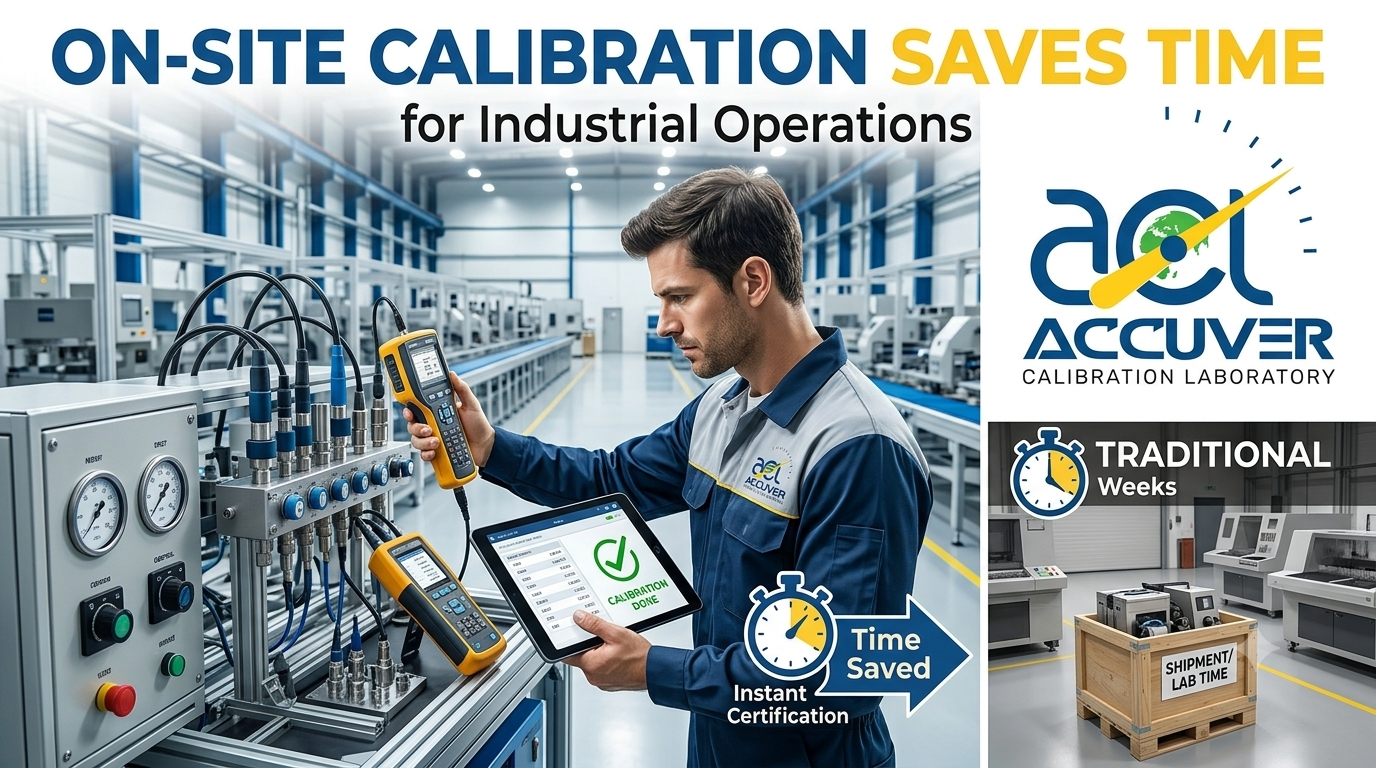
Traditional calibration may require equipment to be removed from the workplace and transported to a calibration laboratory. Although laboratory calibration is useful for many applications, transporting instruments can create delays, handling risks, and additional operational challenges.
On-site calibration UAE services provide an alternative by allowing qualified technicians to perform suitable calibration activities at the customer’s location.
On-site calibration can help businesses reduce equipment transportation, limit downtime, simplify scheduling, and maintain better control over their measuring instruments. It is particularly useful for industrial facilities where equipment is large, difficult to remove, connected to production systems, or needed continuously for operations.
What Is On-Site Calibration?
On-site instrument calibration is the process of testing and, where applicable, adjusting measuring equipment at the location where it is installed or used.
Instead of sending the instrument to a laboratory, a qualified technician brings suitable reference equipment and calibration tools to the customer’s facility.
Depending on the instrument and service scope, on-site calibration may be performed at:
- Manufacturing plants
- Oil and gas facilities
- Power plants
- Chemical processing units
- Construction sites
- Warehouses
- Hospitals
- Laboratories
- Workshops
- Water treatment facilities
- Industrial maintenance locations
The exact service depends on the instrument type, measurement range, accuracy requirements, site conditions, and availability of suitable reference standards.
Not every instrument can be calibrated on-site. Some equipment may require controlled laboratory conditions, specialized systems, environmental stability, or advanced testing facilities.
How On-Site Calibration Saves Time
1. Reduces Equipment Transportation
One of the main advantages of on-site calibration Dubai services is that equipment does not always need to be removed from the workplace.
Transporting instruments may involve:
- Disconnecting equipment
- Removing sensors or gauges
- Arranging packaging
- Preparing transport documents
- Coordinating vehicle movement
- Waiting for laboratory delivery
- Reinstalling the instrument after calibration
These steps can take time and may require support from maintenance, production, engineering, and logistics teams.
With on-site calibration, the technician travels to the facility, reducing the need for unnecessary equipment movement.
2. Minimizes Production Downtime
Some industrial instruments are connected directly to production systems. Removing them may require a shutdown or temporary interruption.
For example, a pressure transmitter installed on a process line may be difficult to remove without affecting operations. A temperature sensor may be part of a production monitoring system. A fixed instrument may also require special access or isolation procedures.
Where technically suitable, field calibration services can allow the instrument to be checked at the facility and help reduce the time it remains unavailable.
On-site calibration does not always eliminate downtime completely. Equipment may still need to be isolated, stopped, or made safe before testing. However, it may reduce the time and effort involved in the overall process.
3. Simplifies Scheduling
Laboratory calibration often requires coordination between the customer and the calibration provider. Equipment must be collected, transported, tested, returned, and reinstalled.
On-site services can simplify scheduling by allowing the calibration provider and facility team to agree on a suitable visit.
This may be especially useful for businesses with:
- Large instrument inventories
- Multiple departments
- Strict production schedules
- Limited maintenance staff
- Remote industrial locations
- Regular calibration requirements
A planned visit may allow several suitable instruments to be checked during the same service period.
4. Reduces Handling and Transit Risks
Some instruments are sensitive to vibration, impact, moisture, temperature changes, or incorrect handling. Transporting them to another location may increase the risk of damage.
Mobile calibration services UAE can reduce unnecessary movement by allowing calibration to take place at the customer’s site.
This may be useful for:
- Large pressure instruments
- Fixed process sensors
- Heavy torque equipment
- Installed electrical systems
- Sensitive laboratory devices
- Instruments that are difficult to package safely
However, site-based calibration still requires proper preparation, protection, and handling procedures.
5. Helps Maintain Equipment Availability
Industrial operations often depend on a limited number of instruments. If one instrument is sent away for calibration, the business may need to use a backup or temporarily change its process.
On-site calibration may help reduce the period during which the instrument is unavailable.
This can support better continuity for:
- Production monitoring
- Preventive maintenance
- Equipment inspection
- Quality control
- Safety monitoring
- Process measurement
- Engineering testing
The actual turnaround time depends on the number of instruments, their condition, test requirements, site readiness, and the availability of reference equipment.
Instruments Commonly Considered for On-Site Calibration
The instruments suitable for on-site calibration depend on the calibration provider’s technical capability and the working environment.
Pressure Instruments
Pressure calibration may be performed on suitable equipment such as:
- Pressure gauges
- Pressure transmitters
- Pressure switches
- Digital pressure indicators
- Pressure calibrators
- Vacuum gauges
- Pressure sensors
On-site pressure calibration may be useful in process plants, mechanical rooms, pipelines, and industrial facilities where removing instruments is difficult.
Temperature Instruments
Suitable temperature instruments may include:
- Thermometers
- Temperature indicators
- Temperature transmitters
- Thermocouples
- Resistance temperature detectors
- Temperature sensors
- Temperature switches
The site environment must be suitable for the required temperature testing. Some high-accuracy applications may still require a controlled laboratory.
Flow Instruments
Flow-related calibration may involve:
- Flow meters
- Flow indicators
- Flow transmitters
- Rotameters
- Water flow instruments
- Air or gas flow instruments
The method depends on the flow medium, range, pipe arrangement, installation conditions, and available reference equipment.
Electrical Instruments
Some electrical instruments may be suitable for on-site calibration, including:
- Digital multimeters
- Clamp meters
- Insulation testers
- Electrical calibrators
- Voltage indicators
- Current measuring instruments
- Frequency meters
Electrical safety and suitable test conditions are important before any field calibration activity begins.
Torque Instruments
Some torque tools may be tested on-site, including:
- Torque wrenches
- Torque screwdrivers
- Torque testers
- Torque transducers
- Powered torque tools
The available service depends on the torque range, instrument design, reference system, and required accuracy.
Dimensional and Mechanical Instruments
Depending on the site conditions, suitable instruments may include:
- Vernier calipers
- Micrometers
- Dial gauges
- Measuring gauges
- Mechanical indicators
- Selected dimensional tools
Highly precise dimensional measurements may require controlled temperature, vibration, humidity, and surface conditions. In such cases, laboratory calibration may be more appropriate.
How On-Site Calibration Is Normally Organized
A successful on-site calibration UAE service requires proper planning between the customer and the calibration provider.
1. Equipment List Preparation
The customer should prepare a list of instruments requiring calibration. The list may include:
- Instrument name
- Manufacturer
- Model
- Serial number
- Asset number
- Measurement range
- Location
- Previous calibration date
- Required calibration parameter
A complete list helps the provider assess the service requirements.
2. Technical Feasibility Review
The calibration provider reviews whether the instruments can be calibrated at the customer’s location.
Important considerations may include:
- Instrument type
- Measurement range
- Accuracy requirement
- Installation condition
- Site accessibility
- Available power supply
- Environmental conditions
- Required reference standards
- Safety restrictions
- Space for calibration equipment
If the site cannot provide suitable conditions, the instrument may need to be calibrated in a laboratory.
3. Site Preparation
The customer may need to prepare the work area before the technician arrives.
Preparation may include:
- Providing safe access
- Isolating equipment where necessary
- Arranging permits
- Cleaning the instrument
- Providing power supply
- Ensuring suitable lighting
- Making equipment available
- Assigning a site contact
- Providing technical documents
Site preparation can reduce waiting time and help the calibration work proceed smoothly.
4. Instrument Inspection
The technician checks the equipment for visible damage, missing parts, contamination, loose connections, and other issues.
If the instrument is not safe or suitable for testing, the technician may recommend repair or further assessment.
5. Calibration and Testing
The technician performs the required checks using suitable reference equipment and an approved procedure.
Depending on the instrument, the process may include:
- Zero checks
- Multiple test points
- Repeatability checks
- Error evaluation
- Functional checks
- Alarm checks
- Adjustment, where appropriate
- As-found and as-left measurements
The calibration method must match the instrument and its intended use.
6. Documentation
After testing, the results are recorded in a calibration certificate or report.
The documentation may include:
- Customer details
- Instrument identification
- Calibration date
- Site location
- Calibration method
- Reference standards
- Test points
- Measurement results
- Error or deviation
- Measurement uncertainty, where applicable
- Environmental conditions
- Technical remarks
- Authorized approval
The certificate should clearly identify that the calibration was performed on-site where relevant.
On-Site Calibration vs. Laboratory Calibration
Both on-site and laboratory calibration have important uses. The right choice depends on the instrument and the customer’s requirements.
| Factor | On-Site Calibration | Laboratory Calibration |
|---|---|---|
| Location | Customer’s facility | Calibration laboratory |
| Transportation | Usually reduced | Equipment must be transported |
| Downtime | May be reduced | May be longer due to transport and scheduling |
| Environmental control | Depends on site conditions | Usually more controlled |
| Large equipment | Often more convenient | May be difficult to transport |
| High-precision work | Depends on site capability | Often more suitable |
| Installed instruments | Can be practical | May require removal |
| Service planning | Requires site coordination | Requires collection and return coordination |
On-site calibration is not automatically better for every instrument. Laboratory calibration may be necessary when the equipment requires controlled conditions, advanced reference systems, or specialized testing.
Factors That Can Affect On-Site Calibration
Several conditions may influence the success of a field calibration visit.
Environmental Conditions
Temperature, humidity, dust, vibration, and electromagnetic interference may affect certain measurements.
Site Accessibility
Restricted areas, height, confined spaces, or difficult access may require additional planning.
Equipment Availability
The instrument must be available and ready for testing. Delays may occur if the equipment is still in use or has not been isolated.
Safety Requirements
Some locations require permits, personal protective equipment, gas testing, electrical isolation, or special access procedures.
Reference Equipment
The calibration provider must have suitable reference standards for the required measurement range and accuracy.
Site Conditions
Insufficient space, unstable power supply, poor lighting, or excessive vibration may make on-site calibration unsuitable.
Benefits for Different Industrial Sectors
Manufacturing
On-site calibration can help manufacturers reduce production interruptions and maintain control over process instruments.
Oil and Gas
Installed pressure, temperature, flow, and electrical instruments may be difficult to remove. Field calibration can support maintenance planning where technically suitable.
Power Generation
Power plants use many instruments for monitoring and control. On-site services may reduce the need to transport large or installed equipment.
Construction
Portable torque tools, electrical instruments, and selected measuring devices may be checked at project locations.
Healthcare
Some medical and laboratory instruments may be suitable for on-site testing, depending on their design and the required measurement conditions.
Water and Wastewater
Flow, pressure, level, and electrical instruments may benefit from calibration services performed at treatment facilities.
Why Choose ACCUVER Calibration for On-Site Services?
ACCUVER Calibration supports organizations that require dependable measurement equipment and structured calibration documentation.
For businesses searching for on-site calibration Dubai, on-site calibration UAE, or mobile calibration services UAE, a professional calibration partner can support:
- On-site instrument assessment
- Field calibration planning
- Pressure calibration
- Temperature calibration
- Flow calibration
- Electrical calibration
- Torque calibration
- Equipment identification
- Calibration documentation
- Calibration status tracking
- Support for industrial measurement equipment
The availability of on-site service depends on the instrument type, measurement range, site conditions, technical requirements, and available reference standards.
Before arranging a visit, customers should provide accurate instrument details and explain any access, safety, or operational restrictions.
Frequently Asked Questions
1. What is on-site calibration?
On-site calibration UAE is the process of testing and, where applicable, adjusting measuring instruments at the customer’s facility instead of sending them to a calibration laboratory.
2. What are the main benefits of on-site calibration?
On-site calibration may reduce transportation, equipment handling, production downtime, scheduling difficulties, and instrument unavailability.
3. Can all instruments be calibrated on-site?
No. Some instruments require controlled laboratory conditions, specialized equipment, or advanced testing facilities. Suitability must be assessed individually.
4. Is on-site calibration as accurate as laboratory calibration?
It can provide reliable results when suitable reference standards, procedures, and environmental conditions are available. However, some high-precision applications may require laboratory conditions.
5. Which instruments can be calibrated on-site?
Depending on the provider’s technical scope, instruments may include pressure gauges, temperature sensors, flow meters, electrical instruments, torque tools, and selected dimensional equipment.
6. Does on-site calibration eliminate equipment downtime?
Not always. Equipment may still need to be isolated or temporarily stopped. However, on-site calibration may reduce downtime related to removal, transportation, and reinstallation.
7. What should a customer prepare before an on-site calibration visit?
The customer should prepare the equipment list, provide safe access, arrange permits if required, make instruments available, and share technical information.
8. Will the calibration certificate mention the site location?
A suitable calibration certificate or report may include the customer’s site details and indicate that the calibration was performed on-site, where applicable.
Conclusion
Industrial businesses need accurate instruments to maintain quality, safety, and reliable operations. However, sending equipment to a laboratory can create transportation requirements, production interruptions, and additional coordination work.
On-site calibration UAE services provide a practical option for suitable instruments by allowing technicians to perform calibration at the customer’s facility. This can help reduce equipment movement, improve scheduling, limit downtime, and support better instrument availability.
On-site calibration is particularly useful for large, installed, sensitive, or operationally important instruments. However, the service must always be evaluated according to the instrument type, technical requirements, site conditions, and required accuracy.
For businesses seeking on-site calibration Dubai, mobile calibration services UAE, or industrial calibration services Dubai, ACCUVER Calibration can support calibration planning and measurement equipment management.
Contact ACCUVER Calibration to discuss your instrument list, site requirements, calibration schedule, and suitable on-site service options.