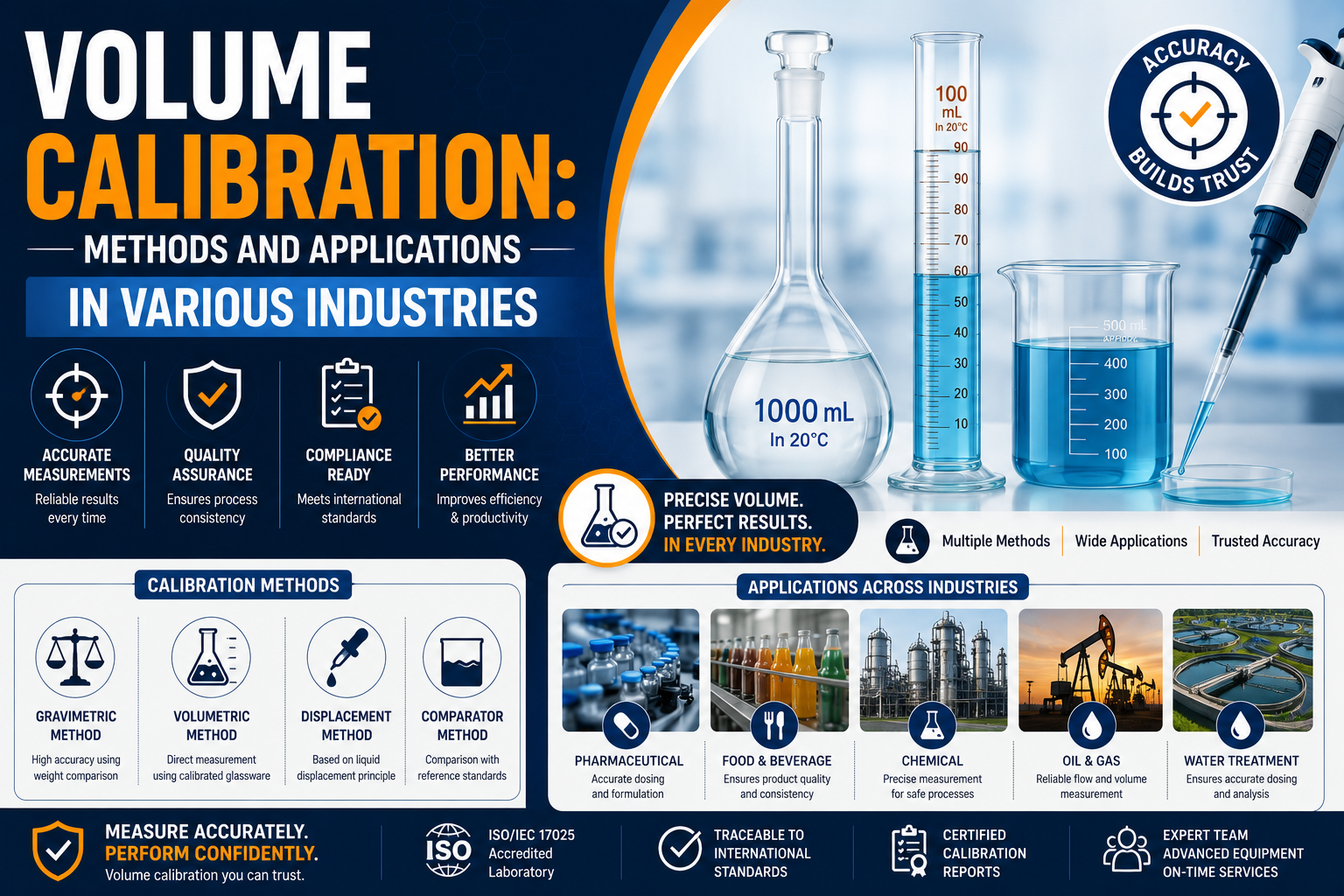
Volume Calibration: Methods, Standards, and Industrial Applications in the UAE
In high-precision industrial operations, measurement accuracy is the foundation of quality control, safety, regulatory compliance, and fiscal equity. Among the various metrological disciplines, volume calibration is critical for sectors handling liquid and gas phases. From micro-pipettes dispensing nanoliters of active pharmaceutical ingredients (APIs) to massive storage tanks holding hundreds of thousands of barrels of crude oil in the UAE’s oil and gas terminals, precise volumetric determination ensures that what is measured matches reality.
For B2B enterprises operating in the United Arab Emirates’ harsh environmental conditions, maintaining the integrity of volumetric measurements presents distinct engineering challenges. Ambient temperatures exceeding 45°C, fluctuating humidity, and high atmospheric pressures demand a rigorous approach to calibration. This comprehensive guide explores the principles, standards, and methodologies of volume calibration, providing the technical insights needed to choose the right metrological strategies for your operations.
—
What is Volume Calibration?
Volume calibration is the process of comparing the actual volume of containment or throughput in a vessel, device, or instrument against a traceable reference standard of known accuracy. This process establishes the relationship between the indicated volume and the true volume, quantifying any systemic errors, biases, or uncertainties.
To understand volume calibration, it is essential to distinguish between the two primary classifications of volumetric apparatus:
- “To Contain” (TC or In): These vessels are calibrated to hold a specific volume of liquid. Examples include volumetric flasks, graduated cylinders, and storage tanks. The liquid film left on the inner walls when emptied is included in the calibrated volume.
- “To Deliver” (TD or Ex): These devices are calibrated to deliver a precise volume of liquid. This includes pipettes, burettes, dispensers, and dynamic flow systems like provers. The calibration accounts for the residual liquid film that naturally adheres to the vessel’s interior surfaces after dispensing.
The Physics of Volumetric Variability
Unlike mass, which remains constant regardless of environmental conditions, volume is highly sensitive to external physical parameters. The volume of both the liquid medium and the containment vessel changes with temperature and pressure. The thermal expansion of the container material is governed by its coefficient of cubical thermal expansion ($\gamma$), while the liquid’s volume varies based on its density-temperature curve.
In a high-temperature region like the Middle East, failing to compensate for these thermal dynamics introduces significant volumetric errors. Accurate volume calibration requires converting all measurements to standard reference temperatures (typically 20°C for laboratory glassware and 15°C or 20°C for industrial petroleum applications).
—
Key Methodologies for Accurate Volume Calibration
Metrologists use three primary methods to calibrate volumetric equipment. The choice depends on the instrument’s size, the required level of accuracy (measurement uncertainty), and the specific industrial application.
1. The Gravimetric Method
The gravimetric method is the primary and most accurate technique for volume calibration, recognized as the standard for laboratory glassware, pipettes, and small-to-medium vessels. It is governed by international standards such as ISO 8655 (for piston-operated volumetric apparatus) and ISO 4787 (for laboratory glassware).
How the Gravimetric Method Works:
- The dry, clean vessel under test is weighed on a high-precision analytical balance.
- The vessel is filled with a reference liquid of known density—typically ultrapure, deionized water.
- The filled vessel is weighed, and the net mass of the water is calculated.
- The water’s temperature, barometric pressure, and relative humidity are measured to determine the precise density of both the water ($\rho_w$) and the ambient air ($\rho_a$).
- The volume is calculated using the fundamental equation, applying corrections for air buoyancy and the thermal expansion of the vessel.
The core mathematical formula used to determine the volume ($V_{20}$) at the standard reference temperature of 20°C is:
$$V_{20} = (m_L – m_E) \times \frac{1}{\rho_w – \rho_a} \times \left(1 – \frac{\rho_a}{\rho_b}\right) \times [1 – \gamma(t – 20)]$$
Where:
- $m_L$ is the mass of the filled vessel.
- $m_E$ is the mass of the empty vessel.
- $\rho_w$ is the density of the calibration water at temperature $t$.
- $\rho_a$ is the density of air.
- $\rho_b$ is the density of the balance calibration weights.
- $\gamma$ is the coefficient of cubical thermal expansion of the vessel material (e.g., $9.9 \times 10^{-6} \text{ K}^{-1}$ for borosilicate glass 3.3).
- $t$ is the temperature of the water during calibration.
Because of its reliance on mass, which can be measured with high resolution, gravimetric calibration offers incredibly low measurement uncertainty. However, it is highly sensitive to evaporation, static electricity, and environmental fluctuations.
2. The Volumetric (Volume Transfer) Method
The volumetric method is a secondary calibration technique that is highly practical for field applications and larger volumes. It involves transferring a liquid from a calibrated reference standard, known as a Standard Volume Measure (SVM) or “prover,” into the vessel under test, or vice versa.
This method is commonly used for calibrating industrial flow provers, fuel dispensers, road tankers, and large laboratory vessels where gravimetric weighing is impractical due to balance capacity limits.
How the Volumetric Method Works:
- A certified reference standard (such as a slicker plate measure or a master meter) is filled to its nominal capacity.
- The liquid is transferred to the vessel being calibrated.
- The liquid level on the scale of the target vessel is read, or the volume is read directly from the graduated neck of the standard.
- Temperature corrections are applied to account for differences between the liquid in the reference standard and the target vessel.
While the volumetric method has slightly higher uncertainty than the gravimetric method, it is faster, highly repeatable, and well-suited for field environments where high-capacity analytical balances cannot operate due to structural vibrations and draft currents.
3. The Geometric Method (Dimensional Calibration)
For large storage tanks, such as vertical cylindrical tanks, horizontal bullet tanks, or spherical gas vessels, neither gravimetric nor volumetric transfer is feasible. In these scenarios, metrologists use the geometric method, commonly known as tank strapping or tank calibration.
This method involves taking highly precise physical measurements of the tank’s dimensions—including diameter, circumference, height, plate thickness, tilt, and internal deadwood (internal structures that displace volume like ladders, pipes, and beams). These measurements are then used to calculate the tank’s volume at various liquid heights, producing a customized Tank Capacity Table (or strapping chart).
Modern Geometric Innovations:
Traditional manual tape strapping is increasingly being replaced by Electro-Optical Distance Ranging (EODR) and 3D Laser Scanning (LiDAR), as outlined in ISO 7507 and API MPMS Chapter 2. These advanced optical methods capture millions of data points to build a digital twin of the tank. This digital model accurately calculates volume even if the tank has structural deformities, tilting, or denting.
—
Environmental Challenges in the UAE: Temperature and Humidity Corrections
Conducting volume calibration in the UAE and the wider GCC region requires a deep understanding of thermodynamics. The local climate presents environmental challenges that can easily introduce errors if not managed correctly.
| Environmental Factor | Impact on Volume Measurement | Mitigation & Calibration Strategy |
|---|---|---|
| Extreme Ambient Temperatures | Causes rapid thermal expansion of metals/glass vessels and decreases liquid density. | Perform calibrations in climate-controlled laboratories (20°C ± 0.5°C) or use real-time mathematical thermal expansion corrections ($Z$-factor adjustments). |
| Low/High Humidity Fluctuations | Low humidity accelerates evaporation during gravimetric calibration; high humidity causes condensation on cold apparatus. | Maintain relative humidity between 45% and 60% in testing labs. Use evaporation traps on micro-pipette calibration balances. |
| Vibrations & Air Currents | Disturbs high-resolution analytical balances, destabilizing weight readings. | Install anti-vibration tables and draft shields. Use massive granite slabs to isolate weighing platforms. |
The Critical Role of the $Z$-Factor
In pipetting and laboratory liquid handling, calibration protocols often use a consolidated conversion value known as the $Z$-factor. The $Z$-factor combines the effects of water density as a function of temperature, air buoyancy at a given atmospheric pressure, and the thermal expansion of the pipette itself.
Because the UAE’s atmospheric pressure can vary between coastal cities like Dubai and inland oilfields, and indoor laboratory temperatures can fluctuate if HVAC systems cycle, metrologists must calculate a localized $Z$-factor for every calibration run. This step ensures that the volumetric measurements remain traceable to international standards.
—
Industry-Specific Applications of Volume Calibration
Volume calibration is a core requirement across many of the UAE’s key industries, each with its own regulatory standards and operational needs.
1. Oil, Gas, and Petrochemicals
In a region dominated by hydrocarbon production, volume calibration is critical for fiscal responsibility. Upstream production, midstream pipeline transport, and downstream refining all rely on precise volumetric tracking.
- Custody Transfer: When millions of barrels of oil change hands, a measurement error of just 0.05% can lead to millions of dollars in financial discrepancies. Displacement provers, master meters, and turbine flowmeters are continuously calibrated to ensure transaction transparency.
- Shore and Road Tankers: Fuel distribution networks rely on calibrated tanker compartments and shore tanks to prevent inventory shrinkage, detect leaks, and comply with customs regulations.
2. Pharmaceuticals and Biotechnology
With the UAE investing heavily in domestic pharmaceutical manufacturing and life sciences, laboratory precision is more important than ever.
- Liquid Handling Systems: Automated liquid handlers, multi-channel pipettes, and micro-dispensers must dispense exact volumes of active compounds. Small errors can ruin chemical assays or result in sub-potent or toxic drug formulations.
- Bioreactors & Compounding Vessels: Volumetric scales on industrial mixing vessels must be calibrated to maintain precise chemical reactions during drug synthesis.
3. Food, Beverage, and Consumer Goods
For local food and beverage manufacturers, volume calibration keeps production running smoothly and ensures regulatory compliance.
- Packaging Integrity: Filling machines must deliver the exact volume printed on the product label. Under-filling violates UAE consumer protection laws (such as those enforced by the Ministry of Industry and Advanced Technology – MoIAT), while over-filling wastes product and reduces profit margins.
- HACCP and Quality Audits: Calibrated dosing pumps ensure that preservatives, colorants, and active ingredients are added in safe, consistent ratios.
4. Water Desalination and Utilities
As one of the world’s leading producers of desalinated water, the UAE relies on massive municipal water infrastructure. Calibrated flow systems, volumetric meters, and chemical dosing systems ensure that reverse osmosis and multi-stage flash distillation plants operate efficiently and safely.
—
International Standards Governing Volume Calibration
To ensure international recognition and trade compatibility, all volume calibrations must align with recognized global standards. Key standards include:
- ISO/IEC 17025: This is the general requirement for the competence of testing and calibration laboratories. Any professional calibration laboratory must be accredited to ISO/IEC 17025 to issue valid, internationally traceable calibration certificates.
- ISO 8655 (Parts 1 to 9): The definitive global standard for piston-operated volumetric apparatus (POVA). It defines the calibration procedures, environmental controls, and maximum permissible errors for pipettes, burettes, dilutors, and dispensers.
- ISO 4787: Covers laboratory glassware, specifying methods for testing accuracy and detailing the proper application of gravimetric volume determination.
- API MPMS (Manual of Petroleum Measurement Standards): Specifically Chapter 2 (Tank Calibration) and Chapter 4 (Proving Systems), which govern the volumetric calibration of large oil storage tanks and dynamic custody transfer systems.
- OIML R 111 & R 120: International recommendations governing standard weights (used in gravimetric calibration) and standard measures for liquids.
—
Selecting the Right Volume Calibration Partner in the UAE
Because volume is highly sensitive to environmental factors and procedural errors, choosing the right calibration laboratory is critical for your operational quality. When selecting a metrology partner in the UAE, look for the following qualifications:
1. ISO/IEC 17025 Accreditation
Ensure your calibration provider is accredited by an internationally recognized body, such as the Emirates National Accreditation System (ENAS) or EIAC (Emirates International Accreditation Centre). This accreditation guarantees that their equipment, technicians, environmental controls, and uncertainty analyses are regularly audited to meet global standards.
2. Traceability to National and International Standards
Every calibration certificate must show a clear, unbroken chain of traceability to primary metrology standards (such as those held by NIST, NPL, or PTB). Without traceability, your calibration data will not hold up during external quality audits or regulatory inspections.
3. State-of-the-Art Environmental Controls
Ask about the laboratory’s climate control systems. A professional volume calibration laboratory must maintain stable temperatures (typically 20°C ± 0.5°C) and control humidity to prevent evaporation errors. If you require on-site calibration, make sure the provider has specialized field equipment, such as mobile provers and portable environmental monitoring systems, to ensure accurate measurements in the field.
4. Comprehensive Documentation and Calibrated Certificates
A valid calibration certificate should contain more than just a “Passed” stamp. It should include:
- The raw measurement data.
- The specific calibration method used.
- An explicit statement of the expanded measurement uncertainty (with a coverage factor of $k=2$ for a 95% confidence level).
- The environmental conditions during the test.
- A clear statement of traceability.
—
Frequently Asked Questions (FAQ)
Q1: How often should volumetric instruments (like pipettes or flow meters) be calibrated?
A: The calibration frequency depends on how often the instrument is used, its criticality to your process, the properties of the liquids being measured, and your internal quality guidelines. For standard laboratory pipettes, a 6-month or 12-month interval is common. For high-volume custody transfer meters in the oil and gas sector, calibration may be required quarterly or even monthly to meet regulatory and financial standards.
Q2: Why is water used as the primary liquid for gravimetric calibration?
A: Ultrapure, deionized water is used because its physical properties are incredibly well-documented. Its density at various temperatures, barometric pressures, and isotopic compositions has been measured with high precision by international metrology organizations. Water is also non-toxic, readily available, inexpensive, and easy to clean, making it the ideal reference medium.
Q3: What is the difference between “To Contain” (TC) and “To Deliver” (TD) calibration?
A: TC (“To Contain”) instruments, like volumetric flasks, are calibrated to hold a precise volume. When you pour liquid out of a TC vessel, a small amount remains stuck to the inner walls, meaning the delivered volume is slightly less than the marked volume. TD (“To Deliver”) instruments, like pipettes and burettes, are calibrated to deliver a precise volume, meaning the calibration process already accounts for the thin film of liquid left behind inside the tip.
Q4: How does altitude or air pressure affect volume calibration?
A: In gravimetric calibration, air pressure affects air density, which in turn changes the air buoyancy force acting on both the water and the calibration weights. If your laboratory does not adjust for local barometric pressure, your mass-to-volume calculations will be incorrect. This adjustment is especially important for facilities operating at different elevations across the UAE.
Q5: Can volumetric vessels be autoclaved without losing their calibration?
A: High-quality borosilicate glass 3.3 laboratory vessels can typically be autoclaved without affecting their calibration, as they have a very low coefficient of thermal expansion. However, plastic volumetric apparatus (made of PP, polymethylpentene, or PFA) can experience permanent dimensional changes when exposed to high heat, which can throw off their calibration. These plastic items should be recalibrated if they are autoclaved.
—
Ensure Measurement Accuracy with ACL
In highly regulated industries, precision is not just a target—it’s a regulatory and financial requirement. Even small errors in volume calibration can lead to compromised product batches, failed regulatory audits, and costly raw material waste.
At ACL, we provide world-class, ISO/IEC 17025 compliant calibration, testing, and engineering services across the UAE. Utilizing advanced metrological equipment, highly controlled laboratory environments, and experienced calibration engineers, ACL ensures your volumetric instruments deliver the highest levels of accuracy, reliability, and international traceability.
Don’t let measurement errors impact your operations. Contact the metrology experts at ACL today to discuss your volume calibration needs, schedule an on-site calibration, or learn more about our comprehensive industrial engineering services.
—SEO_START—
META_TITLE: Volume Calibration Methods & Industrial Applications | ACL UAE
META_DESCRIPTION: Deep dive into volume calibration methodologies, ISO standards, and UAE environmental corrections for oil & gas, pharma, and industrial labs.
IMAGE_PROMPT: A highly detailed, cinematic 3D render of a state-of-the-art metrology laboratory. In the center, a professional calibration rig with a clear glass volumetric flask filled with pure water. Precise blue and amber laser beams measure the liquid level. In the background, out-of-focus analytical balances and stainless steel industrial provers are visible. The atmosphere is sterile and clean, with soft laboratory lighting.
—SEO_END—